Who gets paid when a record plays
There are two separate copyrights inside every recording, and American law treats them so differently that a station can pay for one and not the other. That asymmetry explains the whole system, including the reason a podcast cannot do what a radio station does.
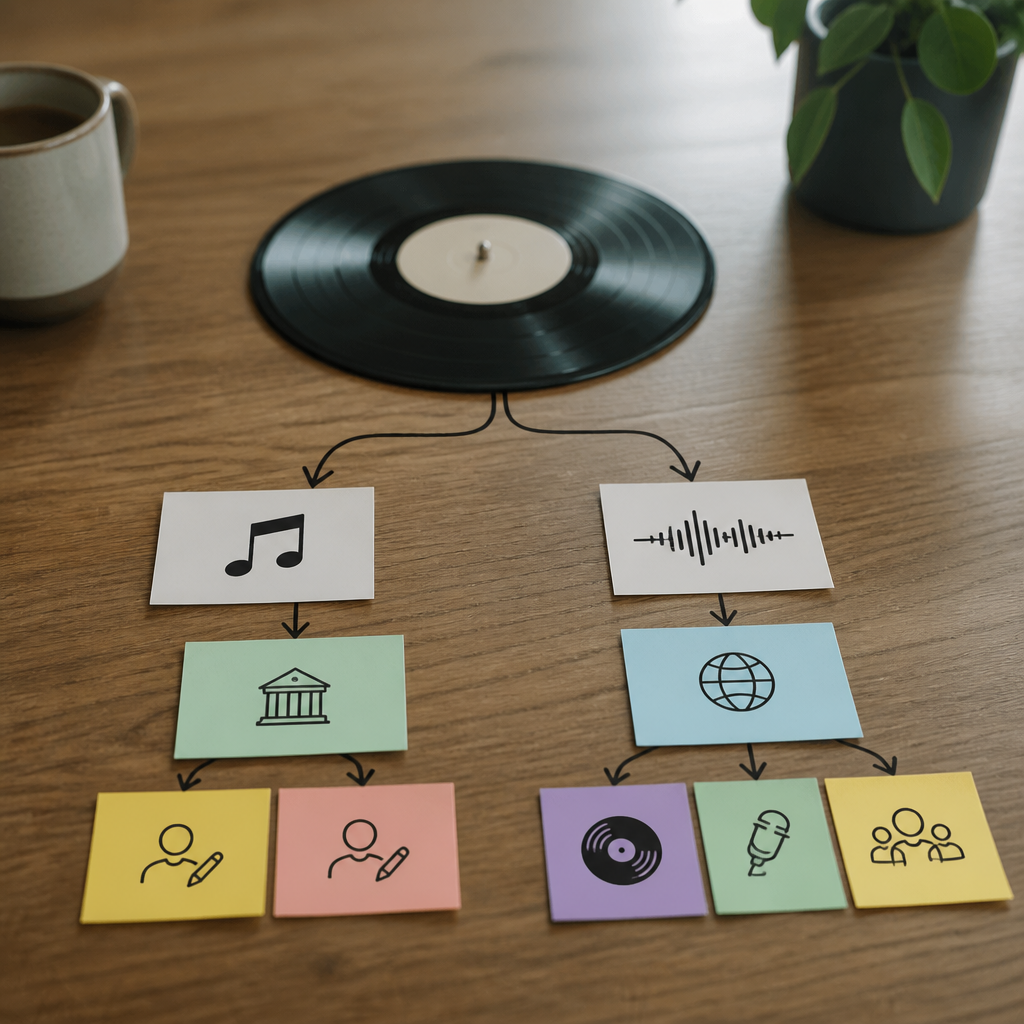
Start with the distinction that everything else hangs from. When a record plays, two different works are being used at once. There is the musical work, the composition itself, the melody and the words, which belongs to the songwriters and their publishers. And there is the sound recording, one specific captured performance of that composition, which belongs to whoever paid for or owns the master, usually a label and sometimes the artist.1
Cover the song yourself and you use only the first. Play the famous version and you use both. Every licensing question in this piece is a question about which of the two is being used, and in what way.
Performing rights, and what a blanket licence buys
The right at stake in broadcasting is the right of public performance. For compositions, that right is administered collectively in the United States by performing rights organisations: ASCAP and BMI, the two largest, along with SESAC and Global Music Rights.
What they sell is a blanket licence. A station pays, usually as a share of revenue, and in return may perform anything in that organisation's repertoire without clearing individual titles. It is a practical solution to an impossible problem: no station could negotiate separately for the several thousand distinct compositions it uses in a month.
Because the repertoires do not overlap, a broadcaster holds licences with several organisations at once, and any one of them is capable of stopping a station from playing a substantial share of its library. The two largest have operated for decades under consent decrees agreed with the Department of Justice, which constrain how they may license and how disputes over rates are resolved.
In exchange, stations report what they played. Some reporting is a census of every performance drawn from the log described in the shape of a broadcast day; some is sampled. The reporting is how money reaches individual writers rather than disappearing into an average.
The American exception
Here is the thing that surprises everyone who learns it, including many people who work in the industry.
United States law gives sound recordings no general public performance right for over-the-air broadcasting. When a record plays on an AM or FM station, the songwriters and publishers are paid through the organisations above. The label and the featured performer are not paid at all for that performance.
An American radio station pays the person who wrote the song and pays nothing to the person who sang it. Almost no other country does it that way.
The asymmetry at the centre of the system
The historical justification was promotional: airplay sells records, so the exposure was treated as payment in kind. The argument has been contested for as long as it has existed, and it has a practical consequence beyond fairness. Because reciprocity in international collection generally depends on offering an equivalent right, American performers can be limited in what they collect from performances abroad.
Legislation to create a terrestrial performance right has been introduced repeatedly, most recently under the name of the American Music Fairness Act, and has been opposed just as regularly, including by a standing congressional resolution known as the Local Radio Freedom Act. Neither position has prevailed, and the exception stands.
Digital transmission, and the licence that changed it
A performance right in sound recordings does exist in the United States, but only for digital audio transmissions. It was created in 1995 and broadened in 1998, and it covers webcasting, satellite radio, and a station's own online simulcast of its broadcast signal.2
For non-interactive services it comes with a statutory licence, which means a service does not have to negotiate with each label. It pays a rate set through a public proceeding and files detailed reports of use. Collection and distribution is handled by SoundExchange, which splits each payment on a fixed statutory basis: half to the owner of the sound recording, forty-five percent to the featured artist, and the remaining five percent to a fund for the non-featured musicians and vocalists on the record.3
The statutory licence is conditional, and the conditions are what keep a webcaster from turning into an on-demand service. There are limits on how many tracks from the same album or the same artist may be played within a given period, a prohibition on publishing the upcoming playlist in advance, and a requirement that the listener cannot choose what plays next. Cross any of those lines and the statutory licence no longer applies; the service must then negotiate directly with every rights holder, which is what an interactive streaming service does.
Where the statutory licence stops
A podcast is downloadable and on demand. That single fact puts it outside every mechanism described so far.
The statutory licence does not apply, because the licence covers non-interactive transmissions and a listener choosing an episode is interacting. A performing rights blanket licence does not solve it either, because a podcast does not merely perform a composition, it reproduces and distributes it, and those are separate rights. And a podcast almost always uses the sound recording as well as the composition, which needs its own permission from whoever owns the master.
So a podcast that wants to use a commercial record needs two direct negotiated permissions: one from the publisher for the composition, one from the recording owner for the master. Both are individually negotiated, both may be refused, and both are priced for the intended use. There is no equivalent of the blanket licence, and no threshold below which a short excerpt is automatically permitted. Fair use exists, but it is a defence assessed case by case rather than a quantity of seconds.
| Use | Composition | Sound recording | Cleared how |
|---|---|---|---|
| Over-the-air broadcast | Yes, performance | No right in US law | Blanket licences with the PROs |
| Online simulcast or webcast | Yes, performance | Yes, digital performance | PRO licences plus the statutory licence |
| On-demand streaming service | Yes, plus reproduction | Yes, negotiated | Direct deals with every rights holder |
| Podcast episode | Yes, plus reproduction | Yes, master use | Two direct permissions, or library music |
| Live event in a venue | Yes, performance | No right in US law | Usually the venue's own blanket licence |
In practice most producers avoid the problem rather than solving it. Production music libraries sell recordings that come pre-cleared for defined uses, at a per-track or subscription rate. Creative Commons material can be used within the terms of its particular licence, which vary considerably and often require attribution or forbid commercial use. And a great deal of the best podcast music is simply commissioned, which is cheaper than most people expect and removes the question permanently.
The other rule that travels with the money
One further obligation belongs beside the licensing ones, because it is about the same thing: being honest about who paid for what a listener is hearing.
American broadcasters must disclose on the air when they have received consideration for broadcasting material, naming the sponsor. The rule is about disclosure rather than prohibition: payment for airplay is not itself illegal, concealing it is. That is the whole of what payola means as a legal matter, and it has produced enforcement action in every decade since the 1950s.4
The equivalent obligation in recorded audio comes from advertising law rather than broadcast law, and it lands in the same place: a paid endorsement is disclosed, clearly, close to the thing being endorsed. Producers who came from radio tend to find this obvious. Producers who did not are the ones who get caught by it.
Notes
- United States copyright law lists musical works and sound recordings as separate categories of protected subject matter, at 17 U.S.C. 102. The separation is not a technicality; the two are owned, transferred and licensed independently. Back
- The digital performance right in sound recordings was created by the Digital Performance Right in Sound Recordings Act of 1995 and expanded by the Digital Millennium Copyright Act of 1998. The statutory licence and its conditions are at 17 U.S.C. 114; rates are set by the Copyright Royalty Board. Back
- The statutory split is fifty percent to the sound recording owner, forty-five percent to the featured artist and five percent to a fund for non-featured musicians and vocalists. It is fixed in statute rather than negotiated. Back
- Sponsorship identification is required by 47 U.S.C. 317 and by the FCC rule at 47 CFR 73.1212. The obligation falls on the licensee, which is why stations require written disclosure from anyone supplying material. Back