A format is a promise about the next song
Not a genre, not a playlist, and certainly not a mood. A format is a commitment that whatever plays next will belong to a set the listener already understands, and every mechanism behind it exists to keep that commitment while avoiding tedium.
The reason someone can turn on a station in an unfamiliar city, listen for eight seconds and know whether to keep listening is that formats are a shared language. The names have been stable for decades and describe an expectation rather than a catalogue: country, adult contemporary, contemporary hits, classic rock, alternative, urban contemporary, regional Mexican, news and talk, sports, religious teaching. None of those names is defined in any regulation. They are trade usage, and they are surprisingly precise anyway.
What makes a format work is not the list of songs. It is the fact that the list has rules, that the rules are followed for months at a time, and that they were chosen to fit an audience the station has measured rather than imagined.
A listener does not choose a station once. They choose it again every three minutes, and a format is the argument for staying.
Why turnover matters more than taste
The library, sorted into categories
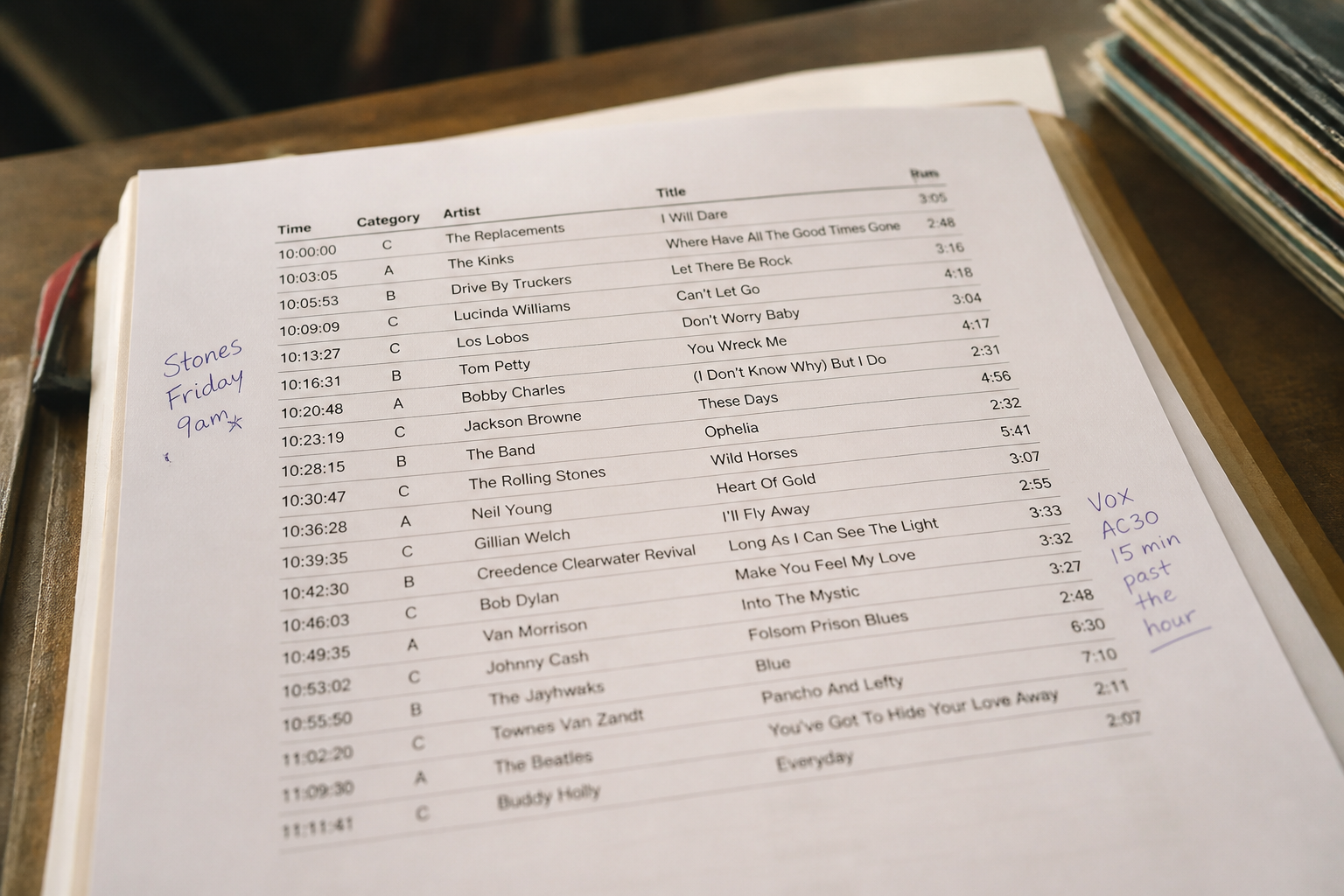
Every title in a station's library sits in a category, and the category decides how often it plays. The names vary between operations; the structure almost never does.
| Category | Contains | Turnover | Purpose |
|---|---|---|---|
| Heavy current | The newest titles the station is committed to | A few hours | Makes the station feel current |
| Medium and light current | New titles still being tested | Half a day to a day | Widens the new music without over-exposing it |
| Recurrent | Recent hits on the way down | Days | Keeps familiarity while making room |
| Power gold | The proven, best-testing older titles | Days | The songs a listener stays for |
| Gold and library | Everything else that qualifies | Weeks | Depth, texture, and surprise |
The concept that ties the table together is turnover: how long it takes a category to play through and start again. A heavy current category of a dozen titles, scheduled once every hour or so, returns to the same song roughly every twelve hours. Shrink the category and the station feels more focused and burns its songs faster. Grow it and the station feels broader and less distinct. Almost every complaint that a station repeats itself is a turnover figure that someone chose deliberately.
Separation, and the rules underneath the rules

Categories decide frequency. Separation rules decide arrangement, and they are what stops a mathematically correct schedule from sounding wrong.
- Artist separation. A minimum time before the same performer returns, and usually a longer one before the same performer appears in the same position in an hour.
- Title separation. A minimum time before the same recording returns, and a rule that stops it landing in the same hour of the day on successive days.
- Tempo and mood. Titles are coded, and the scheduler is told what sequences are acceptable, so that a sweep does not run from ballad to ballad to ballad.
- Era and sound. Codes that prevent three records from the same year, or three with the same production style, from arriving together.
- Vocal type. A rule that avoids stacking similar voices, which is particularly audible at the junction between two songs.
- Dayparting. Certain titles are permitted only in certain hours, because the audience at seven in the morning is not the audience at ten at night.
Every rule reduces the number of legal schedules, and a rule set that is too tight leaves the software with nothing to choose. Loosening one rule to let the hour build is a routine daily decision, and which rule gets loosened says a great deal about what a station believes it is.
Imaging: the station between the songs
Imaging is everything a station says about itself that is not programming: the short recorded elements that carry the name, the jingles, the sweepers that ride over the introduction of a song, and the positioning statement, a single phrase repeated until it becomes shorthand for what the station is.
The craft is in the restraint. A positioning statement works because it never changes and because it names one attribute rather than five. Imaging that describes a station as playing the best variety of everything for everyone is a statement a listener cannot use, and a station with nothing to say about itself usually has nothing to say on the air either.
Benchmarks do a related job at a larger scale: a recurring feature at a fixed time, every weekday, that gives an audience a reason to arrive at a particular minute rather than to drift in. They are the strongest tool a station has for turning reach into time spent listening, which is the trade described in the shape of a broadcast day.
How a song leaves the list

Adding a song is an opinion. Removing one is usually a measurement.
Callout research plays short excerpts, called hooks, to a sample of the target audience and asks three things: do you recognise it, do you like it, and are you tired of it. The third question is the important one. A song can hold a high familiarity score and a high positive score and still be finished, because a large share of listeners have started to skip it.
Auditorium testing does the same at greater scale and depth, with a hundred or more respondents in a room testing several hundred hooks in a session. It is expensive and infrequent, and it is generally used to rebuild a gold library rather than to make weekly decisions.1
Burn is the name for what both are looking for: the point at which familiarity turns into fatigue. It is why a heavily played record disappears from a station while it is still popular, and why it returns two years later in a slower category. Burn is the clock that all the rotation arithmetic is really running against.
Why one owner runs formats that do not compete
Formats are chosen against a market, not in the abstract. The question a programmer asks is not what is good but what is unserved: which audience in this market has no station speaking to it, and is that audience large enough and attractive enough to sell.
American ownership rules make this a group decision rather than a station decision. A single entity may own several stations in one market, with the number capped according to how many stations the market contains and with a limit on how many may be in the same service. The practical consequence is a cluster: several stations under one roof, deliberately programmed at different audiences, sharing a sales team and often a building.2
Inside a cluster, two stations chasing the same listeners is a waste of an asset. So formats are chosen to sit apart, and when a competitor flips to a format the cluster already has, the response is more often to move one of its own stations somewhere else than to fight for the overlap. A period of stunting, a deliberately strange interim sound between two formats, is a way to break the old audience habit before the new format arrives.
None of this transfers cleanly to on-demand audio, and the difference is instructive. A podcast listener chooses each title individually, so there is no next song to promise. What survives is the rest of the discipline: a consistent running time, a predictable release day, a recognisable opening, and a clear statement of what the show is for. Those are format decisions under different names, and the ones that get neglected are exactly the ones a radio programmer would have treated as non-negotiable.3
Notes
- Callout and auditorium testing are long-established industry practices rather than standardised procedures; sample sizes, hook lengths and scoring scales differ between research firms, which is why scores are only ever compared within one methodology. Back
- Local radio ownership limits are set at 47 CFR 73.3555. The caps vary with the number of stations in a market and restrict how many may be in the same service, AM or FM. Back
- Format names are trade usage and are not defined in any regulation. Trade bodies and audience measurement services publish their own classifications, which differ at the edges and are revised as new formats appear. Back